

A tale from Grande Comore: Hadithi ya Ibnaswia
Lesson 3 of 5≈ 10 min
The humorous tale
Not all Comorian tales are tragic or edifying. Many are humorous, playing on the absurdity of everyday situations, the cunning of one character, or the naivety of another.
Hadithi ya Ibnaswia — « The story of Ibnaswia » — is a classic of shiNgazidja, transcribed by Jean-Luc Sibertin-Blanc. It's the story of a man who wants to eat skewers (mshakiki), a fussy merchant, and a transaction that goes awry.
The story (synopsis)
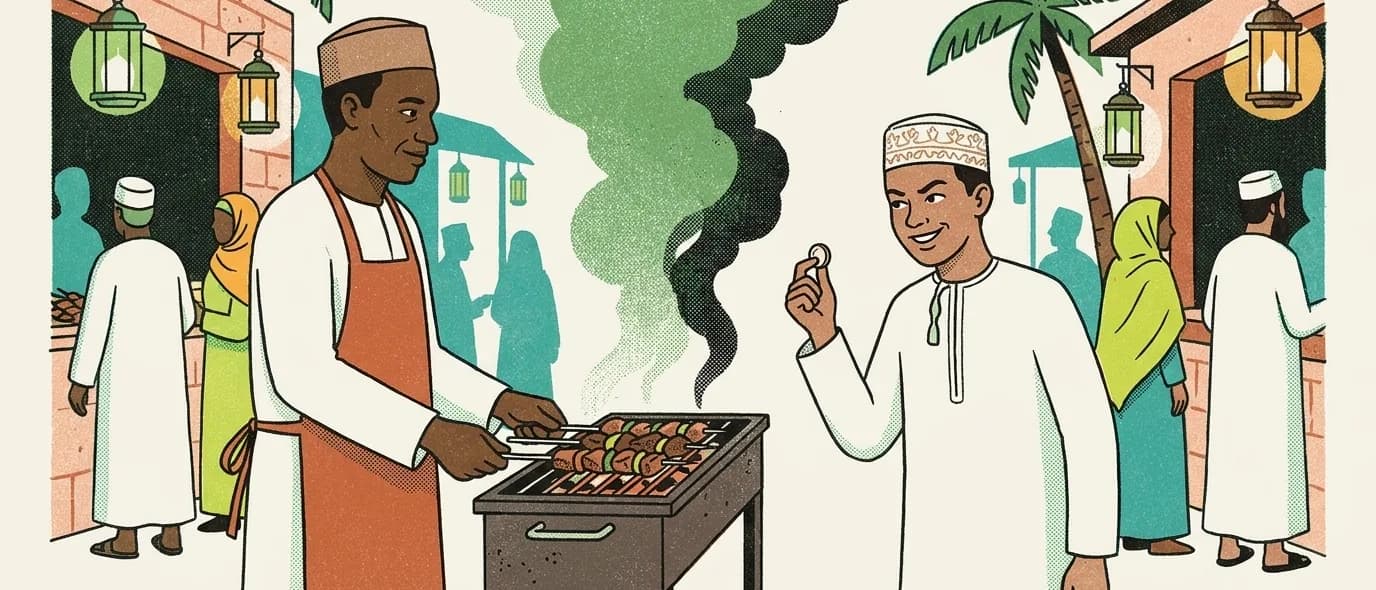
Ibnaswia is hungry. He has a few coins in his pocket. He passes by the stall of a skewer seller (mhoha mshakiki — « he who grills the skewers »).
He asks for skewers. The merchant demands payment before serving. Ibnaswia pays. The merchant puts the skewers on the grill. Time passes. The skewers cook.
Ibnaswia waits. And waits. The merchant, methodical, watches the cooking without haste. Ibnaswia, starving, pulls out his bread (dipe) that he had bought earlier. He starts eating it — without meat. Then he finishes his bread.
When the skewers are finally ready, Ibnaswia is no longer hungry. He has paid, but he no longer wants to eat.
It's a fable about the merchant's greed (making his customer wait) and Ibnaswia's cheerful resignation (adapting rather than complaining).
Key vocabulary of the tale
| Word | Meaning | Note |
|---|---|---|
| hadithi | story, tale | Arabic loan حديث (hadith) |
| mshakiki | (grilled) skewers | Comorian specialty |
| mhoha mshakiki | he who grills the skewers | agent + object |
| dipe | bread | French loan « du pain » |
| Ibnaswia | proper name | « son of Aswia » — traditional given name |
| mfaume | sultan, king | title |
| mapesa | money | plural |
Mshakiki, more than a dish
*Mshakiki is emblematic of Comorian street food. Marinated meat skewers (often zebu or goat), grilled over charcoal, served with dipe (bread) or gato* (savory cake).
In cities like Moroni or Mamoudzou, you'll find mshakiki vendors in the evening at crossroads, around mosques after the Maghreb prayer, or near ferry terminals.
It's also a cultural marker — eating mshakiki together means sharing a convivial moment with friends. The tale of Ibnaswia gently mocks a merchant who would have forgotten this social dimension of food commerce.
The storyteller's art
Ngazidja storytellers are renowned for their mastery of rhythm and punchline. A story like Hadithi ya Ibnaswia can last 30 seconds or 30 minutes depending on the storyteller — who can detail every second of waiting, every thought of Ibnaswia, every movement of the merchant to build up the burlesque.
Tales are often performed rather than simply recited: voice, gestures, pauses, exaggerations. A performance before an audience is a true event.
If you have the chance to attend a storytelling session in Moroni, Anjouan or Mayotte, don't miss it: it's Comorian orality in its purest state.
Practice
Hadithi comes from Arabic and means…
…___.
Mshakiki is…
…___.
Mini-quiz
At the end of the tale, Ibnaswia…
…___ his skewers.
Some cultural vocabulary
A few words that don't really translate into English but that you need to know to understand Comorian culture. Lesson 7.4 introduces you to a selection.