

A tale from Mayotte: Mtru maskini na imauti
Lesson 2 of 5≈ 12 min
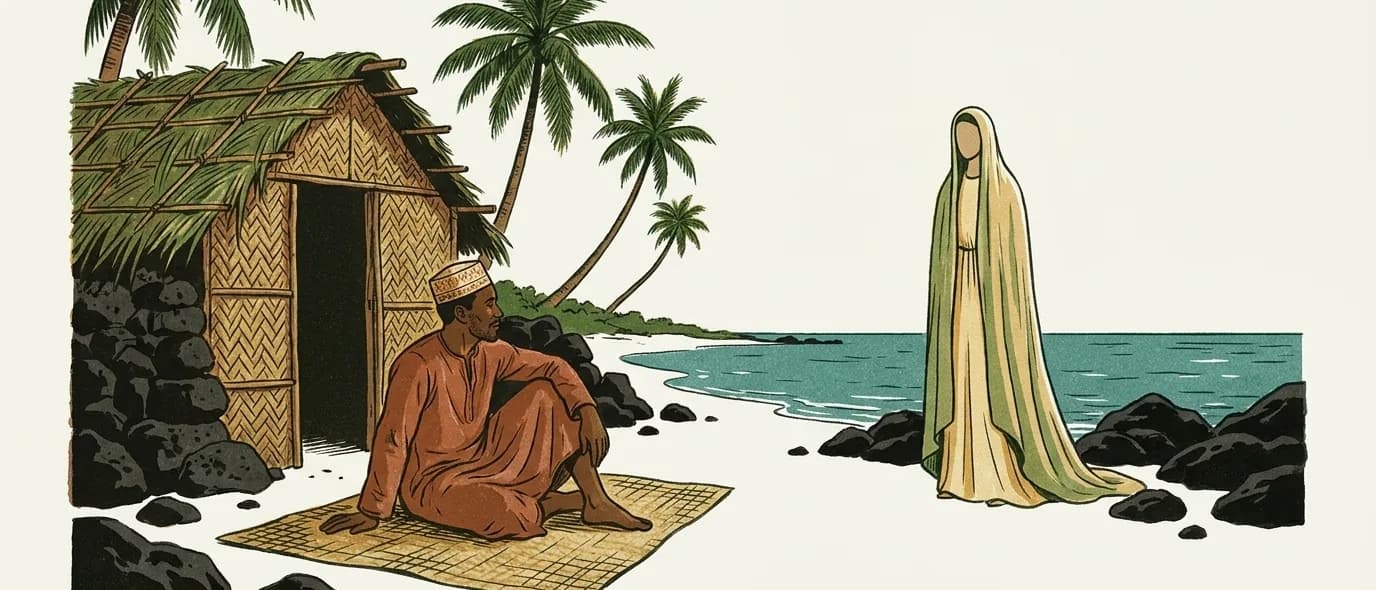
A tale from the oral tradition
The tale Mtru maskini na imauti — « The poor man and death » — is an emblematic story from the oral tradition of Anjouan, transcribed by Mohamed Ahmed-Chamanga in his collection Rois, Femmes et Djinns — Contes de l'île d'Anjouan (L'Harmattan).
It's the story of a man so poor that he calls upon death. He tries to take his own life by jumping from a tree (a kapok tree, mufi), but God miraculously cushions his fall.
Themes: poverty, despair, divine providence, resilience.
The story (synopsis)
In the middle of the night, a poor man, desperate from hunger and loneliness, decides to end his life. He goes to his in-laws' house to beg one last time — without success. Discouraged, he climbs a tall kapok tree and prepares to throw himself into the void.
The moment he leaps, God (Mwene-Mngu) intervenes: he turns the air beneath the man into an invisible cushion, which sets him gently on the ground. Saved against his will, the man understands that his life has a value he had not suspected — and that no despair is final.
He returns home, transformed. The ending hints that he will soon find his livelihood.
Key vocabulary of the tale
| Word | Meaning | Note |
|---|---|---|
| mtru / mutru | man, person | Shimaoré (mndru in Ng) |
| maskini | poor | Arabic loan مسكين |
| imauti | death | Arabic loan الموت (al-mawt) |
| Mwene-Mngu | God | literally « the Master-God » |
| mfua | to eat (dialect form) | poetic variant of hula/ula |
| mufi | kapok tree | tropical tree |
| mapesa | money | plural of pesa, class 5/6 |
| in-laws | — | *hahundu mdruaho yakwe* in the text |
Moral and theological reading
Like many Comorian tales, Mtru maskini na imauti is explicitly religious. Divine providence (Mwene-Mngu protects) is central. This is consistent with a deeply Muslim society where belief in divine omniscience and benevolence is the backdrop of daily life.
But the tale is also anthropological: it tells the poor that they are seen, that their life has value, that nothing is final. In a society where poverty is highly visible, this is a powerful social message.
Children learn this tale from the youngest age. The story depicts poverty without hiding it — a pedagogy of acceptance and hope.
Where to find more tales?
Several reference collections to go further:
- Ahmed-Chamanga, M. Rois, Femmes et Djinns — Contes de l'île d'Anjouan. L'Harmattan. The reference Anjouan collection.
- Sibertin-Blanc, J.-L. Contes ngazidja. Partial collection published in various journals.
- Said, T. Contes et légendes de Mayotte. Recent Mayotte collections.
Oral transmission continues in families, during evening gatherings (kanga) or celebrations. If you have the chance to hear a native storyteller, take the time to listen — it's an irreplaceable experience.
Practice
The word imauti comes from…
…___.
Mwene-Mngu literally means…
the ___-God.
Mini-quiz
The central theme of the tale is…
…___ despite despair.
Heading to Grande Comore
Next tale: Hadithi ya Ibnaswia — a Ngazidja story, humorous this time. The story of a hungry man, a stubborn skewer seller, and a bitter ending.