

Food
Lesson 7 of 13≈ 12 min
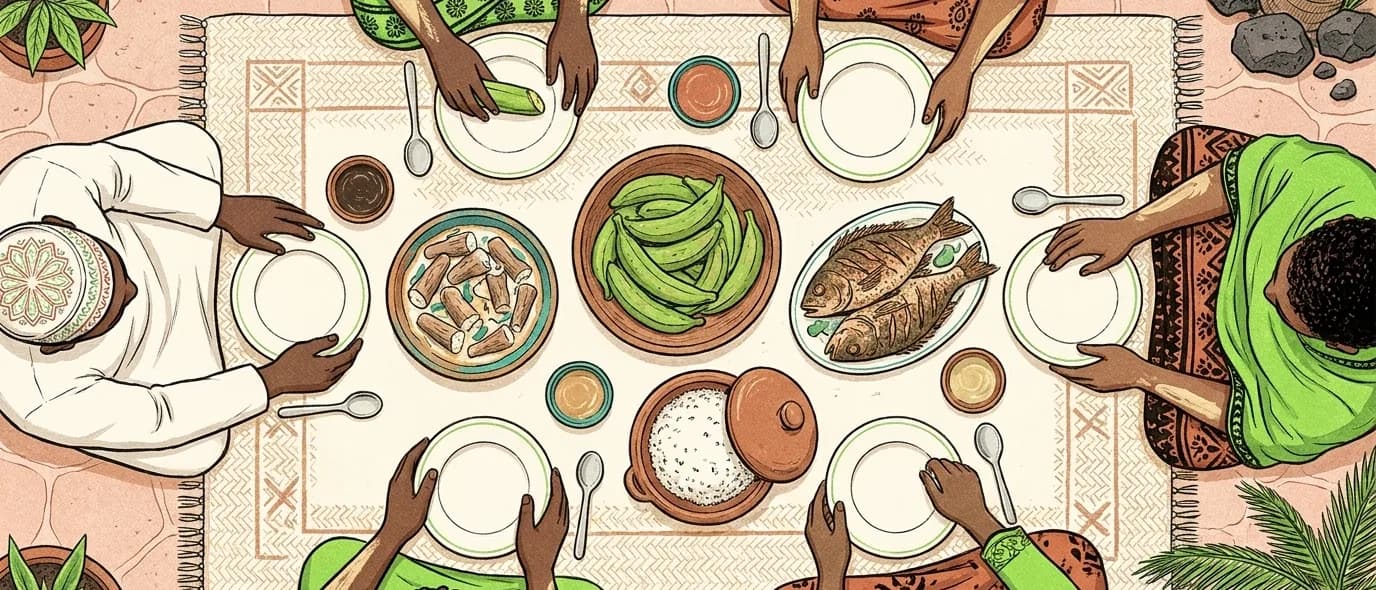
From market to table
Comorian food marries local produce (banana, cassava, coconut, fish) with colonial-era loanwords (bread, cake, tomato). The vocabulary reflects that layering.
A charming detail: dipe (« some bread ») and zalumeti (« the matches ») preserve the French article fused into the word. Typical of oral loanwords.
Food vocabulary
| Shikomori | English | Note |
|---|---|---|
| trovi | green banana | retroflex tr |
| sindza | ripe banana | |
| mhogo | cassava | |
| nyama | meat | digraph ny |
| maele | cooked rice | |
| ntsohole | raw rice | pre-nasal nts |
| fi (Ma, Nz) / nfi (Ng) | fish | nf in Ng |
| vilivili | pepper, chili | reduplication |
| mtrango | pumpkin, melon | pre-nasal m+tr; trango in the Mahoran booklet (p. 32) |
| tamati | tomato | loanword |
| nadzi | coconut | digraph dz |
| mtsolola | meat/fish stew | class 3 |
| dipe | bread | fr. « du pain » |
| gato | cake | fr. « gâteau » |
| ubu | porridge | |
| buyu | baobab fruit | mandatory semi-vowel y |
| mbuyu | baobab (the tree) | pre-nasal mb; mubuyu in the Mahoran booklet (p. 19) |
Listening
- trovi (banana)
- nyama (meat)
- dipe (bread)
- nadzi (coconut)
Loanword vs native: the ɓ/ɗ signature
As you saw in M1.5: native Bantu words often have an implosive ɓ or ɗ, whereas recent loanwords have a standard b or d. Check:
- biro (office, French loan) — standard b
- dipe (bread, French loan) — standard d
- ɓaɓa (dad, Bantu root) — implosive
- mɓuzi (goat, Bantu root) — implosive
The rule has exceptions, but it's a solid heuristic.
Practice
How do you say « green banana »?
« green banana » → ___.
Convert trovi (Ma) into shiNgazidja (green banana).
Source (MA)troviTarget
Mini-quiz
Nyama means…
nyama = ___.
Time to tame time itself
Yesterday, today, tomorrow, the days of the week and holidays. On to time passing.